High vs Low Calves: Can You Fix Calf Genetics?
Some people grow calves by walking upstairs. Others do calf raises for ten years and still get asked if they skip leg day. Most of that gap comes from where the calf muscle ends, and that's set before you ever train.
Key takeaways
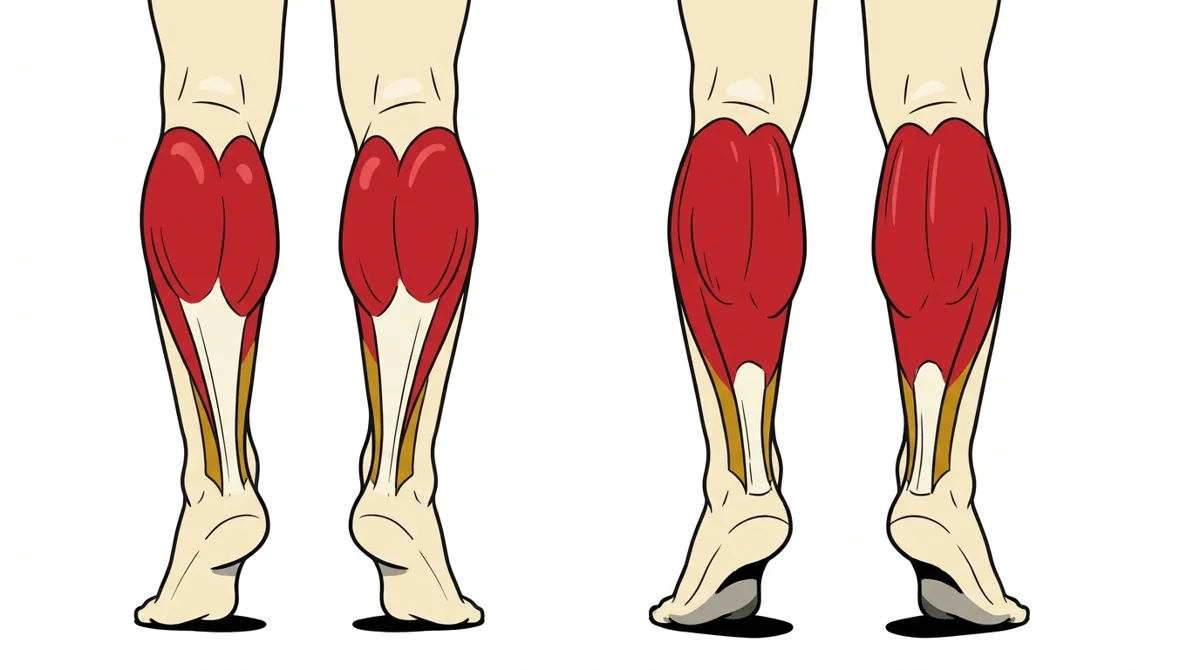
- "High calves" means short calf muscle bellies and a long Achilles tendon. "Low calves" fill the lower leg.
- You can't change the insertion. You can make the muscle you have much bigger.
- High calves need more frequency, a deep stretch at the bottom of every rep and heavy loads.
- The soleus, the flat muscle under the calf, adds width low on the leg. Train it with bent-knee raises.
What "high" and "low" calves mean
Your calf is mostly two muscles: the gastrocnemius, the diamond-shaped muscle you see from behind, and the soleus underneath it. Both join the Achilles tendon, which attaches to the heel.
The tendon doesn't grow. Only the muscle belly does. So if your gastrocnemius is short and the Achilles is long, there's simply less muscle to grow, and a visible gap sits above the ankle no matter how hard you train.
How to tell which calves you have
- Stand barefoot and rise onto your toes, facing away from a mirror.
- Look where the inside head of the calf ends. Measure from the bottom of that bulge to the floor, and from the floor to the back of your knee.
- If the calf belly ends above the halfway point of your lower leg, you have high calves. Around or below halfway is average to low.
The free genetics test asks about your calves along with 7 other insertions.
What training can and can't do
| Can't change | Can change |
|---|---|
| Where the calf muscle ends | How thick the muscle you have becomes |
| The length of the Achilles | The soleus, which adds width low on the leg |
| Your bone length | Body fat around the ankle, which changes how the leg looks |
High calves can absolutely get bigger. They just start from a smaller muscle, so they need a better plan than "a few sets at the end of leg day".
How to make stubborn calves grow
1. Full stretch, every rep
The calf is short and stiff, so most people bounce through the top half of the movement. Lower until your heel is as deep as it goes, hold about one second in the stretch, then press all the way up. No bouncing, no partial reps.
2. Heavy and hard
Calves are built for endurance, but they still need heavy work. Use 6–12 reps on standing and leg press raises and 10–15 on seated raises, taken to 0–2 reps from failure.
3. More frequency
High calves respond better to 3–4 hits a week than to one big session. Spread 10–16 direct sets over the week, and train them first on some days, when you're fresh, instead of always last.
4. Both muscles
Straight-knee raises (standing, leg press) train the gastrocnemius. Bent-knee raises (seated) shift the work to the soleus. Do both every week.
| Exercise | Reps | Why |
|---|---|---|
| Standing calf raise (machine or Smith) | 6–12 | Heavy load, full stretch on the gastrocnemius |
| Leg press calf raise | 8–12 | Easy to load, deep stretch |
| Seated calf raise | 10–15 | Soleus: width low on the leg |
| Single-leg dumbbell raise on a step | 8–15 | Home option, fixes left-right differences |
The complete calf plan
Stubborn Calves has the best exercises ranked, specialization volume and complete plans for 5, 4 and 3 days a week, plus a home version and Achilles care.
See Stubborn Calves: $14.99