Feeder Sets: How to Warm Up Before Heavy Lifting
The warm-up has one job: get you to your first hard set warm, sharp and fresh. Ten minutes on a bike doesn't do it. Five light sets of 15 do it too well: you show up to the real work already tired. Feeder sets are the middle path.
Key takeaways
- Feeder sets are short warm-up sets that get heavier, done before the first hard set of an exercise.
- The standard ramp: 12–15 reps at about 35%, 3–4 reps at about 75%, and on heavy compounds an optional 1–2 at about 90%.
- They should never be tiring. If you're breathing hard after a feeder set, it was too long.
- Use them on the first exercise for each muscle. Later exercises for the same muscle need one feeder set or none.
What a feeder set is
A feeder set "feeds" the movement into your nervous system. The light set warms the joints and lets you rehearse the groove. The medium set tells your body a heavier weight is coming. The near-max single or double, on heavy lifts, makes the working weight feel lighter when you unrack it.
None of them should take anything away from the sets that count. That's the difference between a feeder set and a "warm-up set" of 15 reps with 60% of your weight: that second one is already a moderate set.
The protocol
| Step | Weight | Reps | Rest after |
|---|---|---|---|
| 1. Light feeder | ~35% of working weight | 12–15, smooth and easy | 30–60 s |
| 2. Medium feeder | ~75% | 3–4, fast and crisp | 60–90 s |
| 3. Heavy feeder (optional) | ~90% | 1–2 | 90 s–2 min |
| Hard set 1 | 100% | Your rep range, 0–2 from failure | 90 s–2 min, longer on compounds |
| Hard set 2 | 100% | Your rep range, 0–2 from failure | Next exercise |
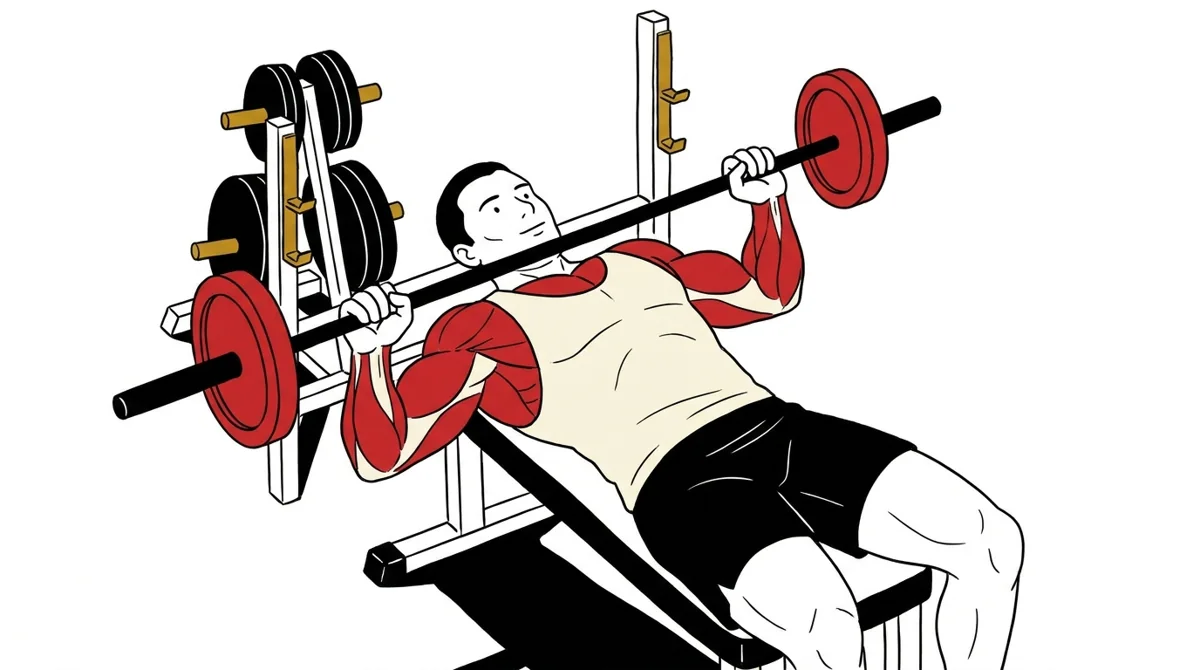
Example for a 225 lb bench press working weight: bar plus 25s (95 lb) for 12, 165 lb for 4, 205 lb for 1, then two hard sets at 225.

Get your feeder weights automatically
The progressive overload calculator gives you next session's working weight and the feeder sets that go with it.
Open the calculatorBefore the first exercise: 5 minutes, not 20
Before the first lift of the day, spend about 5 minutes getting warm: a few minutes of easy cardio or brisk walking, then a handful of movements for the joints you're about to use (arm circles and band pull-aparts for an upper day, bodyweight squats and leg swings for a lower day). Then go straight to the feeder sets. Long static stretching before lifting is not needed.
Second and third exercises
Once a muscle is warm, it doesn't need the full ramp again. For the second chest exercise after bench press, one medium feeder (3–4 reps at about 70%) is plenty. For isolation work after compounds, often none is needed at all: the first hard set at a controlled tempo is its own warm-up.
Common mistakes
- Too many reps in the medium and heavy feeders. 8 reps at 80% is a set, not a warm-up.
- Skipping feeders on heavy days. The first hard set then becomes the warm-up, and you lose reps.
- Resting 3 minutes after every feeder. They're light: keep the warm-up moving.
- Counting feeders as working sets. They don't count toward your weekly volume.

Part of the method
The Warm-Up & Feeder Protocol is a bonus guide inside The Natural Mass Method, with the feeder table for every exercise in the plans.
See The Natural Mass Method